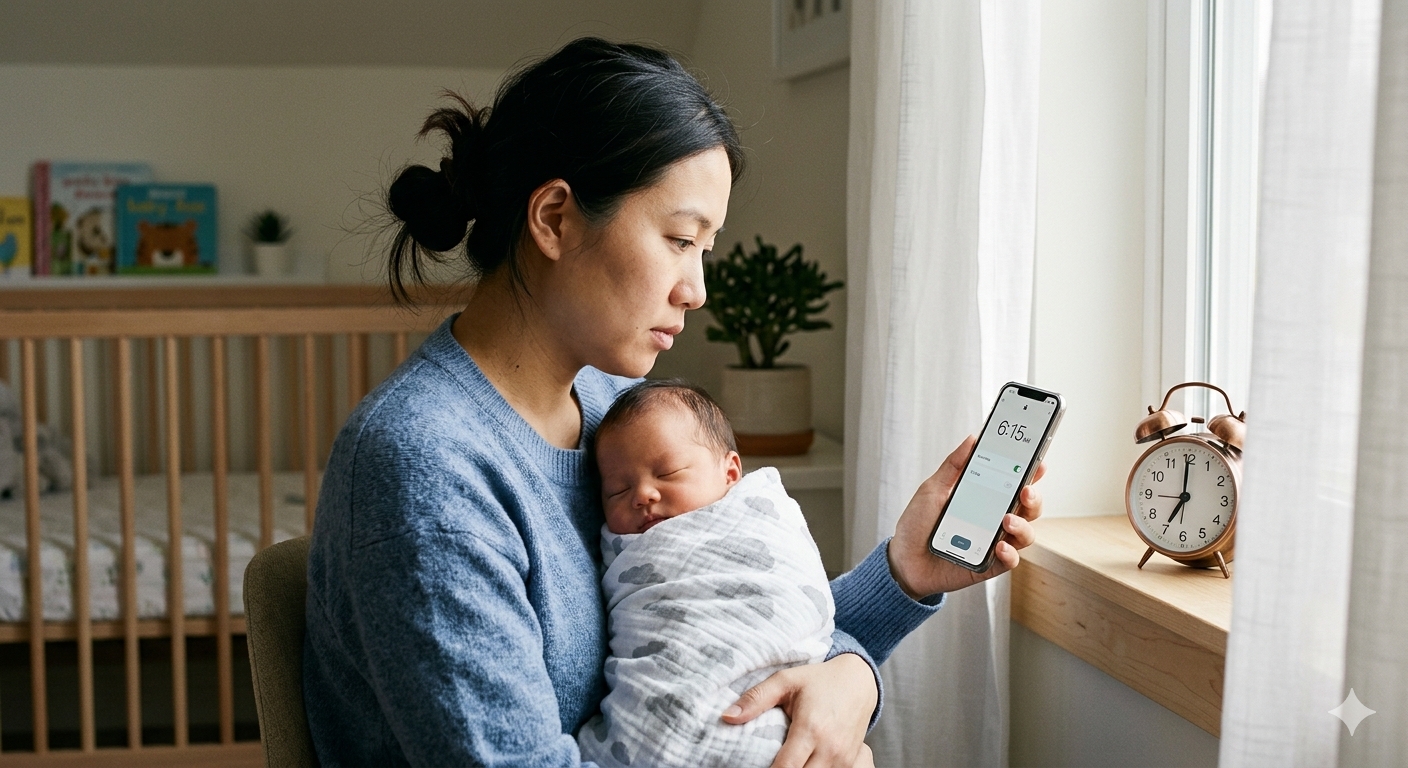
Just when you finally get your newborn into a semi-predictable rhythm, the calendar throws a major wrench into your plans: Daylight Saving Time.
Whether it is setting the clocks forward in the spring ("spring forward") or turning them back in the autumn ("fall back"), that one-hour shift can feel like a total disaster when you are already living on broken sleep. You might be frantically searching: Will daylight savings ruin my baby's sleep? How do I adjust a newborn's schedule?
Take a deep breath. Newborn sleep is naturally fluid, which actually works to your advantage. Here is an easy, stress-free guide to navigating the time change completely pain-free.
The Good News About Newborns and Daylight Savings
If your baby is under 3 to 4 months old, you can breathe a massive sigh of relief.
Newborns do not have a fully developed circadian rhythm (our internal 24-hour biological clock that responds to light and dark). Their sleep is primarily driven by two things: a structural need to eat every few hours and their raw sleep pressure (how long they have been awake).
Because they don't care what the wall clock says, a one-hour shift won't disrupt them the way it disrupts a toddler or an adult. You do not need to overthink a complex, week-long transition plan for a young newborn.
Strategy 1: The "Fall Back" Transition (Autumn)
When the clocks move back one hour in the autumn, the biggest hurdle is that your early riser might start waking up even earlier. If they usually wake at 6:00 AM, the new clock will suddenly read 5:00 AM.
To help smooth out the transition, focus entirely on their wake windows (the amount of time your baby can comfortably stay awake between naps):
Strategy 2: The "Spring Forward" Transition (Spring)
Moving the clocks forward by an hour means your baby will technically "sleep in" an extra hour on the clock. If they usually wake at 7:00 AM, the new clock will read 8:00 AM.
While this sounds like a dream, it can push their entire daytime schedule later, leading to a late bedtime.
3 Secrets to Protect Baby Sleep During the Shift
No matter the season, you can use environmental cues to help program your baby's developing internal clock:
The Bottom Line
Don't let the clock stress you out. At the newborn stage, rigidity is the enemy of peace. Stick to your baby's natural cues, watch their wake windows, and your family will adapt to the new time within just a few days!
